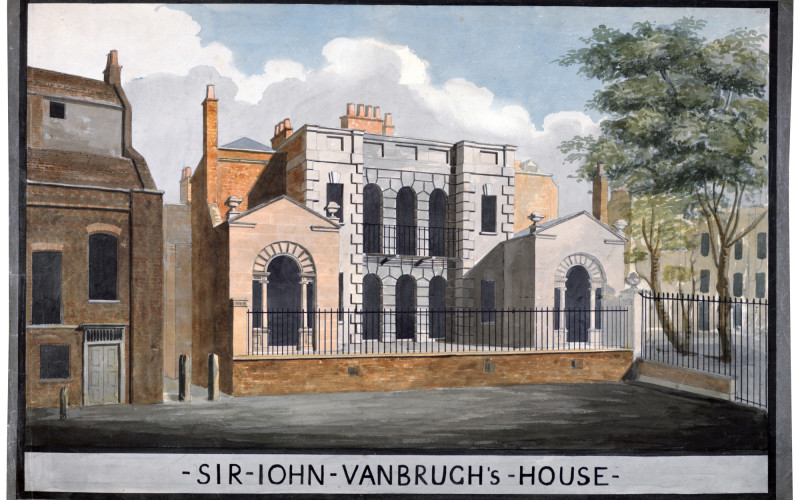
 During the last decade of Vanbrugh’s life, neo-Palladian architects, led by the 3rd Earl of Burlington, began disparaging Vanbrugh’s work. With their monotonous, dogmatic adherence to Palladio, they found Vanbrugh’s buildings too chaotic. They were particularly scathing about his use of proportion, citing Goose Pie House as evidence of his lack of training. Fortunately however, Vanbrugh’s fall from grace was short lived, and neoclassical architects a generation later were more generous.
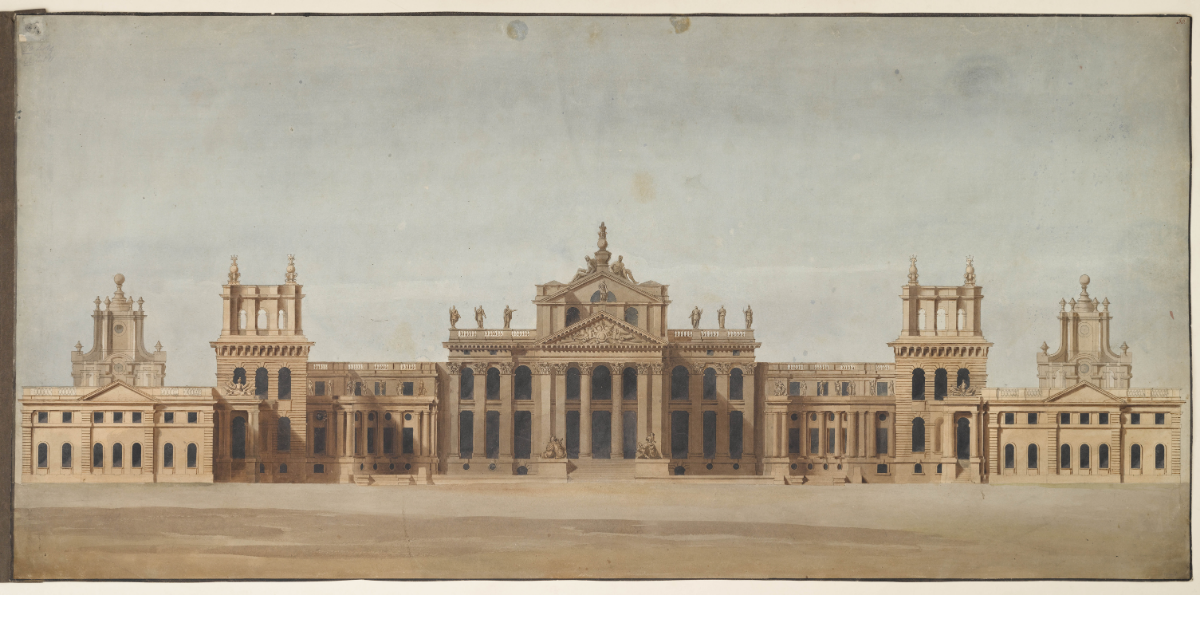
In 1758, while travelling with Alexander Carlyle and others, James Adam visited Blenheim. Carlyle reported that ‘Though he [James] did not say that Sir John Vanbrugh’s design was faultless, yet he said it ill deserved the aspersions laid upon it, for he had seen few palaces where there was more movement’. Doubtless the Vanbrugh-tinged style of Adam’s architect father, William Adam – notably at Arniston and Hopetoun – had influenced him in Vanbrugh’s favour. James’s brother Robert Adam was more tempered in his praise. In the introduction to his 1773 publication Works in Architecture…. Robert declared: ‘Vanbrugh understood better than either [Jones or Wren] the art of living among the great’. His work had ‘movement, novelty and ingenuity’, but ‘his taste kept no pace with his genius’ and his buildings were ‘crowned with barbarisms and absurdities’.
William Chambers was kinder, if brief, in mentioning Vanbrugh during his 1770s Royal Academy lectures, stating that he ‘will always be admired by men of true judgement’. But is was not until 1786 and Joshua Reynolds’ 13th Discourse at the Royal Academy – he being revered there as the first President – that Vanbrugh’s image was resuscitated. Reynolds remarked that Vanbrugh offered a ‘greater display of imagination than we shall find perhaps in any other’.
By the second generation of neoclassicists, Vanbrugh’s standing was finally truly revived. John Soane was effusive in praising Vanbrugh in his 1809-36 lectures at the Royal Academy. In his 5th lecture Soane tells us, ‘In his [Vanbrugh’s] bold flights of irregular fancy, his powerful mind rises superior to common conceptions, and entitles him to the high distinctive appellation of the Shakespeare of architects. To try the works of such an artist by the strict rules of Palladian tameness would be like judging the works of mighty darings of the immortal bard by the frigid rules of Aristotle.’
And thus, one century on from his death, the Vanbrugh-renaissance was fixed.
 Back to homepage