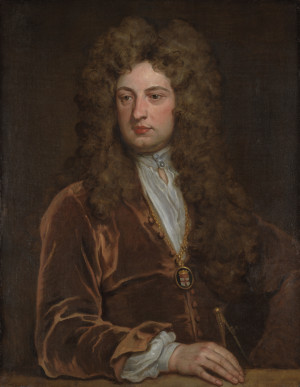
When Vanbrugh died in 1726, his exuberant English Baroque style was already largely out of fashion, superseded by the calm restraint of the Palladians. Yet, like Wren, the sheer scale of Vanbrugh’s achievement could not be ignored, in contrast to Hawksmoor who largely disappeared from view for two centuries following his death. Robert Adam and John Soane were unusual at the time in both being avowed Vanbrugh fans, but both had no time for Hawksmoor. Class undoubtedly played a part, with Soane, a notorious snob, referring to Hawksmoor only as ‘the pupil’ – whether of Vanbrugh, Wren or both, it’s unclear.
If Vanbrugh’s reputation never sunk to the same degree as Hawksmoor’s, neither did it match the latter’s meteoric rise in the second half of the twentieth century, through the pioneering scholarship of Kerry Downes, the work of the Hawksmoor Committee who drew attention to the parlous state of many of his works, and a generation of architects who saw in his stark, abstract compositions fertile material for their own formal explorations. But of the two, it is Vanbrugh, however, who arguably has the more interesting place in the context of a key transitional moment in twentieth-century architecture in the work and writings of Alison (1928–93) and Peter Smithson (1923–2003), and Robert Venturi (1925–2018).
Although close in age, the Smithsons and Venturi advanced what are conventionally seen as diametrically opposing architectural philosophies in Brutalism and Postmodernism respectively, though both shied away from these respective monikers. Where Brutalism constituted a doubling down on modernist tenets via its structural honesty, extreme truth to materials and, as was especially the case in the Smithsons’ work, progressive social programmes, Postmodernism embraced, to use Venturi’s characterisation, complexity and contradiction, rejecting modernist abstraction and embracing historical styles and the aesthetics of the everyday.
Yet Brutalism and Postmodernism were arguably branches from the same tree, resting on analyses of architectural history and broader culture that were in fact closely related. Both movements were interested in the city ‘as found’, valuing what was already there – both in terms of architecture and the social patterns and cultures that had grown up in it – rather than seeking to wipe the slate clean as first-generation modernists had suggested. And both movements were interested in the ways that architecture existed in a broader cultural continuum, looking back to architectural history and across to the signs and symbols of mass culture.
If one were to try to locate a distinct point of intersection, it would be in the common interest in Vanbrugh’s architecture. For the Smithsons, Vanbrugh created what they called ‘multiple fields’, that is, layered, clustered and interconnected compositions, where the space between buildings was as rich and complex as the buildings themselves. Venturi, meanwhile, admired the ambiguity of Vanbrugh’s work, in scale and in the way elements had dual functions or meanings, and how he created complex wholes through fragmentation.
This is not to say there weren’t fundamental divergences between the two movements – there were – rather, where they differed was more in the Smithsons and Venturi built on these analyses than in the analyses themselves. Where the Smithsons liked complexity, Venturi liked complexity and contradiction – which he explored in different ways across his pioneering work Indeed, for all the commonalities in their positions, the Smithsons remained committed modernists, driven by the belief in architecture’s ability to change the world, while Venturi sought ultimately to transcend the modern movement, revelling in the world as it was. It is testament to the enduring genius of Vanbrugh’s work that it would attract the admiration of architects of such seemingly different outlooks, and, even more so, be the place where two apparently opposing architectural movements would intersect.
 Back to homepage