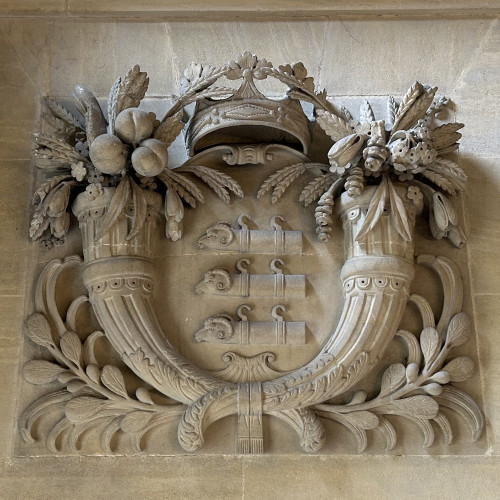
Vanbrugh was appointed Clarenceux King of Arms, a senior herald at the College of Arms, on 3rd April 1704. The College of Arms dates back to 1484 when King Richard III granted the heralds a charter of incorporation.
The Heralds come under the authority of the Earl Marshal, a hereditary office held by the Dukes of Norfolk. When the Earl Marshal’s Catholic faith or age prevented him from carrying out his duties, a deputy was appointed, usually a member of the extended Howard family. Hence the 3rd Earl of Carlisle as Deputy Earl Marshal nominated Vanbrugh to Queen Anne (all heralds are appointed by the monarch).
The College of Arms hierarchy comprises three King of Arms (Garter, Clarenceux and Norroy & Ulster), six heralds, and four pursuivants (or junior heralds). Garter is the most senior herald with Clarenceux in second position. The heralds were responsible for great ceremonies of state such as Coronations, the State opening of Parliament and State funerals. However, their day-to-day work concerned proving rights to existing coats of arms and applications for new ones; family history research; and answering general enquiries. At the end of the seventeenth century the heralds were reliant on minute salaries and their shares upon partition of fees. As Clarenceux King of Arms, Vanbrugh would have received a larger share of the fees. So, to have made fun of heralds with his comic character Quaint in his 1696 play Aesop, must have been particularly galling to his new colleagues as he helped himself to a lion’s share of the fees.
Perhaps surprisingly, Vanbrugh was a regular attendant at the regular Chapter Meetings held by the heralds. Only when he was out of town did he miss the meetings, showing that he took the role of Clarenceux more seriously that he has been sometimes given credit for.
Can we see the influence of heraldry in Vanbrugh’s architecture? At a period when heraldry takes a much less prominent role in domestic architecture, Vanbrugh cannot resist the sheer theatricality of it. It is at Grimsthorpe in Lincolnshire that we really see heraldry coming into its own in Vanbrugh’s architecture. The 2nd Duke of Ancaster’s coat of arms crowns the parapet forming a focal point for the north front. The shield is flanked by a friar and a savage – or wildman – the Willoughby de Eresby supporters (the Duke was also Lord Willoughby de Eresby). Above the shield is a duke’s coronet, peer’s helm and the Willoughby crest of a Saracen’s head ducally crowned. The plinth they stand on is carved with the motto LOYALTY ME OBLIGE (‘Loyalty binds me’). The Bertie arms – three battering rams – are repeated on the frieze above the twin columns, while the Willoughby arms – Or fretty Azure – is used just above on the underside of the cornice.
Inside, the monumental aptly named Vanbrugh Hall, again references the Bertie arms. They appear on carved tablets and on the inside of the front door, while the Saracen’s head crest is carved in high relief on the classical frieze. The crest also appears on the Mannerist chimneypiece and some of the furnishings such as the chandeliers and hall chairs.
Vanbrugh continued as Clarenceux King of Arms until he resigned on 9 February 1725. Today, his portrait hangs in the College of Arms and serves as a reminder of one of its more illustrious officers.
 Back to homepage