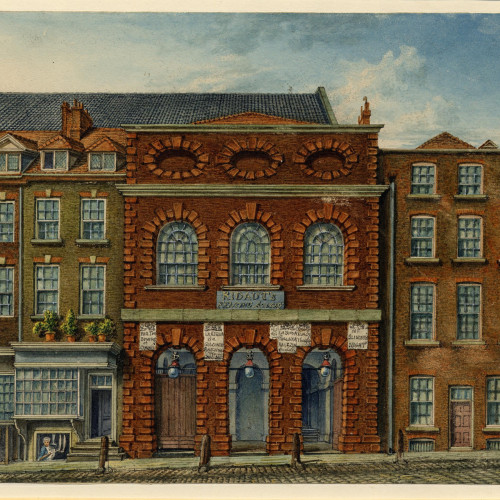
In 1703, John Vanbrugh—dramatist and architect—described his design for a new theatre as “very different from any Other House in being…”
The design—a Royal Theatre for the public realm—was a project he conceived both to promote theatre as an art form and to demonstrate the unique range of his skills in a poetic synthesis: an expressive architecture for drama and scenic theatre, aligned with the political ideology of his investors and friends. It was also a business venture.
His architectural reference points are not wholly clear. He no doubt recalled theatres he had seen after his release from the Bastille in late 1692. He was in direct dialogue with Christopher Wren, Nicholas Hawksmoor, and perhaps even Robert Hooke. He knew Italian sources, such as Sebastiano Serlio’s treatise, and was aware of the new opera-house ideas of Andrea Pozzo. In London, there were public scenic theatres dating from 1661, although only Wren’s 1674 Theatre Royal, Drury Lane approached the scale and ambition Vanbrugh had in mind.
The theatres of this new era had to accommodate musical-scenic drama: a form derived from the royal court but now brought into the public realm. Internally, this required a double-chamber organisation: the social logic of the audience in one volume, and the scientific logic of the perspective stage in another. This posed a fundamental problem of geometry, form, and changing theatrical convention.
Wren, the scientist-architect, addressed this primarily as a technical problem of sight and sound, producing a workable and successful—but, as John Dryden described it— "Plain House” .
Vanbrugh, however, sought to engage more fully with the problem. In doing so, he—somewhat unwittingly, it might be said—defined a moment at which English architecture took on an exacting task: first, to improve and stabilise the still unresolved balance between the social and technical demands of the newly developed English musical-scenic theatre inherited from the court; and second, to anticipate the technical demands of Italian opera, then only beginning to be introduced in this country.
His design—his architectural play —had the potential to work; but only when the building was altered and forced toward the more specific theatrical prescription did it fully do so. In this sense, he looked to find a better balance within current theatrical practice even as he anticipated both a new form of production and an architecture capable of housing it.
He was an adventurer. Like Inigo Jones in the previous era, he wanted to show what architecture could do for theatre. He undertook an experiment—one that Jones had side-stepped (notably in 1630 at the Cockpit-in-Court), and that Wren had moderated—to balance more equally the competing technical and social demands within a new and ‘triumphal’ Palladian-influenced interior, and in doing so to take the question a step further.
He got things built. In this case, a design ahead of its time: one requiring years of alteration, and a shift in dramatic form—a transformation toward Italianate opera—before it could truly work.
We can now see that the design was pioneering, and that it ultimately became an artistic success. George Frideric Handel, who had presented the first Italian opera composed for England there in 1711, returned as director in 1720 and secured its reputation—if not its financial stability—for nearly a decade and a half.
For Vanbrugh—'Mr. Van’—this design in built form, so “very different from any Other House”, was no folly, but rather a painful foray into theatre design in London at its most complex moment.
 Back to homepage