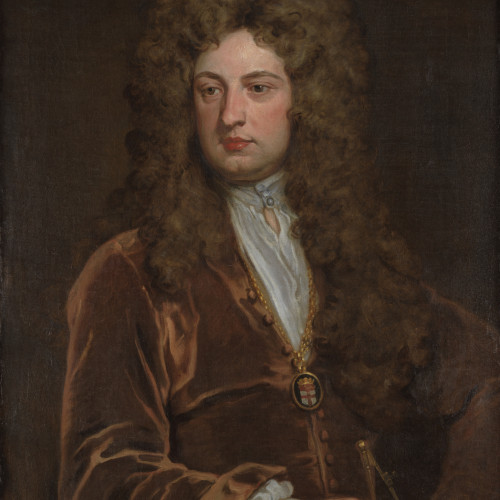
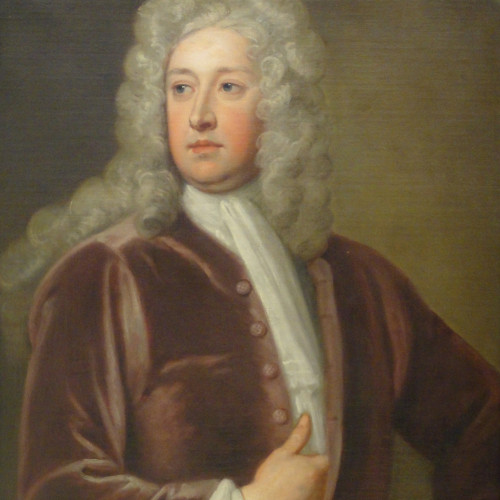
Thomas Archer (1668-1743) has long been overlooked in architectural history, so it is unsurprising that nothing has previously been written about his interactions with Vanbrugh. It is time, however, that this is corrected, as their remarkable careers overlapped at several points, with evidence suggesting that they were well acquainted.
Similarities between the gentlemen are clear. Both enjoyed successful careers outside of architecture, Vanbrugh within the military and as a playwright, and Archer in the role of Groom Porter, which placed him in charge of gambling across Court. They each created some of the country’s best known garden buildings, and crossed over into landscape design, with the intellectual capability to express ideas in multiple genres. Archer and Vanbrugh were well-travelled individuals, who would have been able discuss the latest aesthetic fashions with ease.
Archer’s familial background was slightly more prestigious, but research has shown that the men were related by marriage; Archer’s sister had wed into the Croft family of Herefordshire, and Vanbrugh’s father had married the daughter of Lucy Croft and Sir Dudley Carelton. This connection would ultimately have thrown the men together, even if they hadn’t met through architecture.
Archer is not directly mentioned in Vanbrugh’s correspondence, but this is not unusual; he remains frustratingly elusive in documentation throughout the period, likely reflecting Archer’s need to avoid and transcend court politics. Whilst Vanbrugh could be openly Whig, the lifelong term of the Groom Porter role would have required Archer to ingratiate himself with whoever was rich and powerful under any parliament or monarch, and therefore, to remain politically ambiguous. His friendship with such an overtly political figure may, therefore, have needed to remain discreet.
Their architectural careers first collided around 1705, whilst Vanbrugh was working on Blenheim and Archer on Heythrop Park, the estates set just 9 miles apart. Vanbrugh is known to have visited Heythrop and regularly commented upon its progress in his letters, and conversely, Archer’s patron Charles Talbot, the Duke of Shrewsbury, was one of several individuals whose architectural opinion was sought by the Duke of Marlborough on Blenheim. The proximity of their country house projects came even closer in the 1710s, at Chettle and Eastbury, this time with the estates directly adjoining. Their paths may also have crossed at Kimbolton, where Archer likely designed the portico on the east front, just a few years after Vanbrugh’s remodelling of the Castle. The portico is nearly identical to those on Archer’s church of St John, but is pared back in detailing, perhaps as a mark of respect for his colleagues’ work.
Their lodgings were also in close proximity within the former Whitehall Palace complex. Vanbrugh’s ‘Goose Pie’ house was on Whitehall Court, with Archer’s residence set a short distance away on Middle Scotland Yard, close to that of Wren and immediately next-door to the Duke of Shrewsbury when in office as Lord Chamberlain. This would have formed a vibrant architectural hub, particularly when Archer and Vanbrugh were both working on the Commission for Building Fifty New Churches in London from 1711. The commission minutes record them collaborating regularly, whetherassessing masons’ proposals, visiting potential sites or solving the problem of sinking foundations on Archer’s church of St. John’s.
These details suggest that the pair enjoyed a quiet, unpublicised friendship bound by their love of building. They clearly formed a formidable architectural force.
 Back to homepage