Sir John Vanbrugh was born in 1664 and so was eleven years older than Sir James Thornhill. While the latter was serving his ‘Gentleman’s’ apprenticeship under Thomas Highmore (1689-1696), Sir John was soldiering, spying and travelling. As the fledgling painter’s apprenticeship was coming to an end, Vanbrugh had returned to the country and was pursuing a career as Playwright: The Relapse (1696) and The Provoked Wife 1697 and on to The Confederacy (1705). The indications are that Thornhill saw them all and became in the words of Graham Barlow truly ‘A Man of the Theatre’.
1705, the year of The Confederacy, was crucial in fact in the forming of the professional relationship between the two men. It was when Thornhill received four major independent commissions, two for the theatre and two for architecture. The two for theatre were first designing and painting the stage sets for Thomas Clayton ‘s, Arsenoё, Queen Cyprus at the Drury Lane theatre. It was an important occasion for it was the first of its kind in London and its success was in part due to its originality but also the striking split-level (the first such) stage sets and four of the designs for which have happily survived and are now in the V & A. It has been suggested that one of them may have been the inspiration for the layout of Vanbrugh’s Seaton Delaval.
The second was the invitation from Vanbrugh to do the sets for the first production in his new Queen’s Theatre in the Haymarket that opened that year (perhaps The Loves of Ergasto?). It poses the question as to why he was chosen to do two such important sets – the answer can only be that he was already well acquainted with theatrical matters, was indeed an expert on sightlines, stage scenery and perspective. He was a man whom Vanbrugh knew he could trust with the sets for his new venture.
Barlow takes it further, tracking down a drawing in Thornhill’s sketchbook with designs for a theatre that exactly match the dimensions of the new Queen’s Theatre. Either this was Thornhill making notes for his stage sets or else he was having a say in the design of the theatre (as was to be the case later in the design of the theatre he and Thomas Highmore created in Hampton Court for George I). Barlow makes play also of the similarity of the proscenium arches in Thornhill’s drawings and how they match that of Vanbrugh’s theatre.
Addiscombe Place, Blenheim Palace and Grimsthorpe Castle
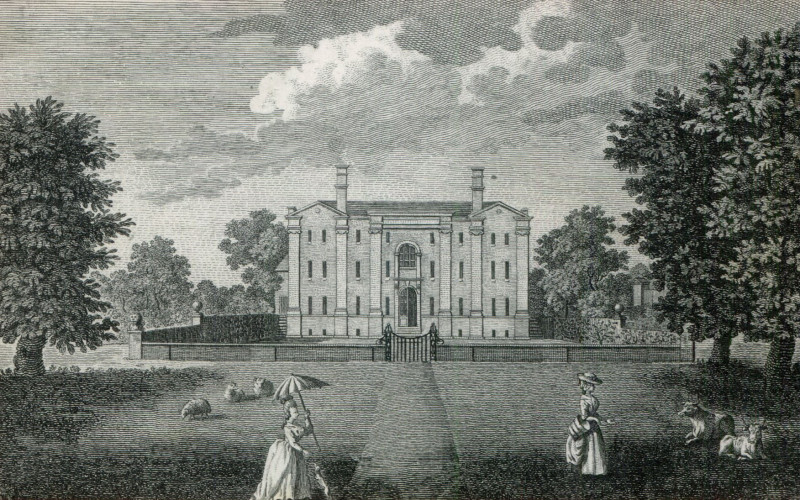
Thornhill’s two mural commissions of 1705 were first for Stoke Court in Herefordshire for Thomas Foley, MP, after Greenwich Hospital and the Cupola of St. Pauls Cathedral, his most extensive commission. (1) The other was one of the four of the great houses that are attributed to Vanbrugh: Addiscombe Place (1705), the others being Blenheim Palace (1716), Eastbury Park (after 1719) and Grimsthorpe Castle (after 1722).
Addiscombe was built for William Draper, son-in-law of the diarist John Evelyn. Thornhill painted the stairwell and the saloon of which we have a full description, but the house itself was demolished in 1861 by the British Land Company for a housing estate. (2)
Thornhill was closely involved with Blenheim Palace. He was one of the party that went to the Netherlands in 1711 to arrange for the trophy Louis XIV had erected over the gateway of Tournai which he had captured but later lost to Marlborough and which yet stands on the roof of Vanbrugh’s Blenheim. Initially he got on well with the Duchess and she supported his abortive attempt to obtain the office of Surveyor which provoked Vanbrugh to expostulate to a Mr. Brobart:
Twou’d be a pleasant Joke to the world, to see a Painter made Surveyor of the work in order to save money when all the small knowledge or taste they ever have of it, is only the great expensive part, As collumes, Arches Bas reliefs etc which they learn enough of to help fill up their pictures. But to think that a Volatile Gentleman as Thornhill , Shou’d turn his thoughts and Application to the Duty of Surveyor’s business, is a Monstrous project.
This from a man who turned from comedy to architecture in 1699, inspired by Hawksmoor!
At Blenheim the painter decorated the ceiling of the entrance hall (The Glorification of the Duke of Marlborough) and was to have done more but the Duchess baulked at his charge (£987), turning to Louis Laguerre instead. Vanbrugh was supportive of Thornhill’s work and when the Duchess was having doubts about the whole project, attempted to calm her nerves by pointing out:
Mr. Thornhill goes on a pace in the Hall and has begun with a better Spirit in his paintings than any I have seen of his doing before. (1716)
It is apparent that they spent much time together at Blenheim. At Grimsthorpe Thornhill’s work was much less spectacular, limited to paintings in grisaille in the hall of figures from English history (William the Conqueror, Edward III, Henry V, George I, William III, Henry VIII, and Henry VII), all quite muted but complementing well the architecture of Vanbrugh. Thornhill also painted the ceiling of the staircase (Apollo and the Muses, oil on canvas).
Eastbury House
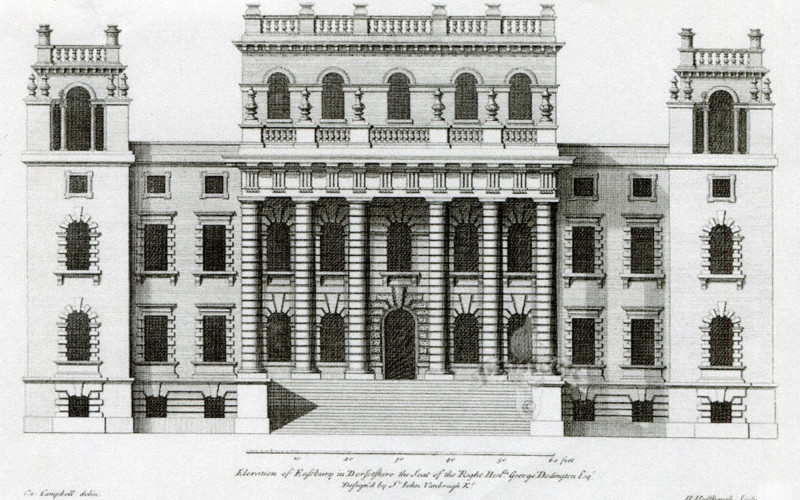
Sources on Eastbury are scarce and the matter is made no easier by reason of the demolition of the house not long after it was built. George Dodington (c.1658-1720) had amassed a vast fortune through office and was bent on building a grand country seat in Tarrant Gunville, Dorset. Vanbrugh was chosen as the architect; a model was made and work started around 1718. Dodington died in 1720, long before completion, leaving his wealth to his nephew who took the name of George Bubb Dodington. In his will he stated that his personal estate was to be vested in trustees for 30 years to buy land preferably in Somerset and Dorset, the income of which was to be applied to the completion of the great house he was building at Eastbury in Dorset. The work was to be executed “according to the model” under the direction of my good friend Sir John Vanbrugh”.
The model is of course not to be found but Vitruvius Britannicus gives us the ground plan and gives the front elevation, grand indeed. The first we hear of Thornhill’s part in it is a letter he wrote to Dodington (which includes a drawing):
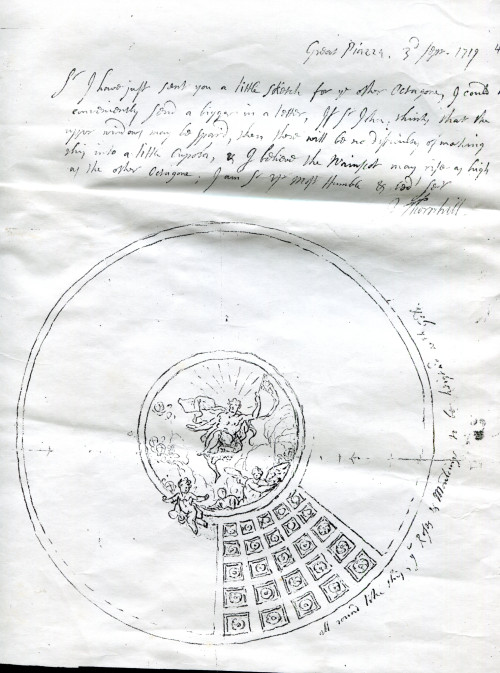 Grand Piazza 3rd Sep 1719
Sir, I have just sent you a little sketch for your other Octogone. I could not conveniently send a bigger in a letter. If Sir John thinks the upper window may be spared then there will be no difficulty of making this into a little cupola, I below believe the wainscot may rise as high the other Octogone’,s
I am Sr ye most Humble obdt Svt
JThornhill ( )
When Dodington died, George Bubb Donington (Thornhill’s neighbour in Grand Piazza, Covent Garden), threw himself wholeheartedly into the completion of the house, eventually achieved in 1753 at a cost of some £140,000, the second most expensive house of that century after Blenheim. On Vanbrugh’s death in 1726, Roger Morris was employed to finish the building and did make significant modifications to the design.
Surviving drawings indicate Thornhill painted Bacchus, Venus and Ceres on the ceiling of the dining-room inscribed Histories proper for a dining Room, or to ye Pavilion of a seat in Hunting Country. In the Chapel was the Ascension, remarkably similar to that over the altar in the chapel of the Queen’s College, Oxford. The best description of the house as it was is to be found in Hutchins The History and Antiquities of the County of Dorset.
Out of this there emerged what Antony Brackenbury in Country Life (1956) describes as “The Happy Eastbury Circle”. The host was of course Dodington, wit, classical scholar with a deep knowledge of Tacitus (but capable on occasion of being coarse and vulgar). The clubbable Thornhill, who in 1720, had repurchased the family manor of Thornhill in Stalbridge (and in 1722 was elected MP for Weymouth and Melcombe Regis doubtless looked in from time to time, James Thompson might be heard reading from the MS of The Seasons, or Edward Young from Night Thoughts. Charles Bridgeman designed the garden, and Charles Pitt, Rector of Pimperne and poet who saw himself as the new Dryden (posterity has not confirmed this) must surely have read his works too. They came and went as opportunity beckoned and Vanbrugh is known to have been there in October 1723, June 1724 and May 1725; even Voltaire looked by for a while.
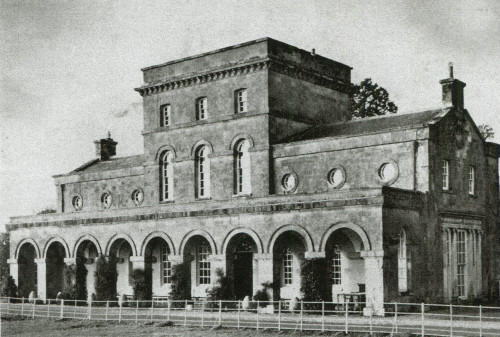 What is left on the ground? Vanbrugh’s great archway with two fir trees growing out of the top, the piers of the gateway and the colonnaded stable-block (now a private residence), plus a few humps and mounds of a once great garden. Not much to show for all expenditure of money and artistic vison, nor much to demonstrate of the creative genius of Sir John and Sir James.
Sir John and Sir James were two of the greatest creative masters of their age, the one embellishing the work of the other. Theirs was a professional partnership forged in the theatre and then carried further when the one, “the Venerable Father of the English School”, added the marvels of his mural painting to the architectural marvels of the other. It is an artistic partnership to be cherished and wondered at.
- Croft- Murray avers that that in the staircase Thornhill for the traditional proscenium arch he substituted an arch elliptical, a feature he borrowed from Vanbrugh.
- 2. While it seems to be generally accepted that Addiscombe was Vanbrugh’s creation, Edward Croft-Murray (Decorative Painting in England1527 -1837, Vol. 1, p 260) hedges his bets and suggests either Vanbrugh or Hawksmoor. The author leaves it to those more expert in the field to make judgement.
Select Bibliography
BARLOW, Graham Vanbrugh’s Queen’s Theatre in the Haymarket 1705-9) (Early Music, November 1989, Vol. 17, no. 4, pp 515-21 )
BRACKENBURY, Anthony The Happy Eastbury Circle (Country Life) 1956
BURLING, William J A Checklist of New Plays and Entertainments in the London Stage 1700-1737 (Associated UP) 1993
CAMPBELL, Colen Vitruvius Britannicus
CROFT-MURRAY, Edward Decorative Painting in England 1537-1837 (Country Life ) 1962
DOWNeS, Kerry Sir Jon Vanbrugh – a Biography (Sidgwick and Jackson) 1989
HUTCHINS, John The History and Antiquities of the County of Dorset (W. Bowyer and J Nicholls) 1774
THORNHILL, Sir James Sketchbook (British Library)
WHISTLER, Laurence Sir John Vanbrugh: Architect and Dramatist 1988
The Imagination of Vanbrugh and his Fellow Artists 1954.
 Back to homepage