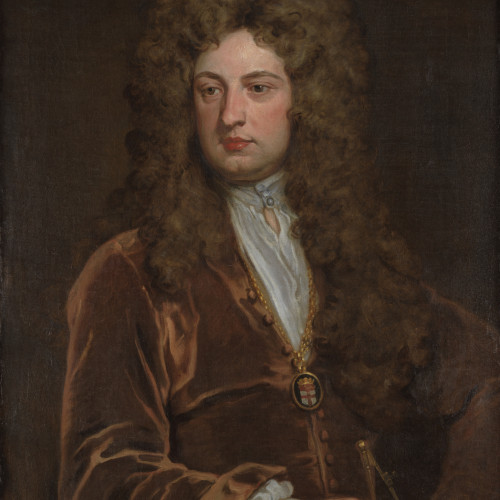
Whig Political Views
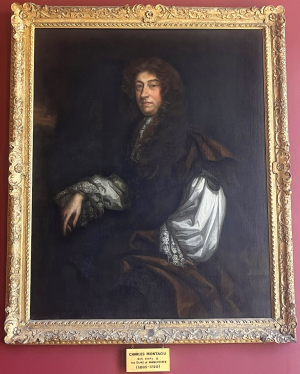 It is in Vanbrugh’s political views that we first establish an affinity with Charles Montagu. The Earl of Manchester was following a similar political journey to Vanbrugh in finding his loyalty to the King at variance with his belief in constitutional government and the Church of England. Only two years older than Vanbrugh, by 1688 he had come a long way from his office of Carver to the Queen, when James and Mary of Modena were crowned in 1685, to one where he was contemplating rebellion. Charles Montagu had an audience with William to consider the viability of removing James II. On returning to England, he raised a troop of horses in Nottingham and joined William when he landed in Torbay. The Earl played a key role in the coronation of William and Mary in 1689, carrying the St Edwards Staff. Furthermore, he played an important part in seeing off a renewed challenge from the exiled James II in 1690, fighting with William III at the Battles of the Boyne and Limerick. Thus by 1690, both Manchester and Vanbrugh were committed Whigs. In addition, they both knew Paris, with the Earl serving as English Ambassador to France between 1699-1701. Although they both disliked the French political system, they were influenced by French culture and new buildings such as the Place Vendome and Les Invalides.
Playwright and Member of the Kit Cat Club
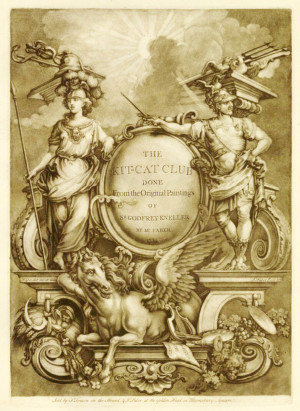 Membership of the Kit Cat Club was a vital breakthrough for Vanbrugh as it gave him access to leading Whig influencers, including Charles Montagu, with whom he became friends. This was not just a mere acquaintanceship, but one of shared cultural vision and a love of the theatre. They exchanged frequent gossipy correspondence about London society and the theatre. Charles Montagu was well travelled and had visited Venice as far back as 1687, before his diplomatic postings there in 1697-98 and 1707-1708. As Helen Jaconsen has written, ‘his cultural patronage included Italian artists, architects, upholsterers, and cabinet-makers, and he proved himself to be a fervent patron of Italian music’.
When Vanbrugh extended his interests to design his own theatre, the Queen’s Theatre in the Haymarket, Montagu was a key patron. The theatre was the largest in London and designed to accommodate an art form of mutual admiration, opera. Manchester clearly recognised talent and helped broker a deal with the famous alto castrato Nicola Grimaldi to sing in London. He also introduced Vanbrugh to Giovanni Antonio Pellegrini who painted the murals at Kimbolton Castle and Castle Howard.. Indeed, recent research by Julie Brown suggests that the theatrical connection with Vanbrugh explains the mystery of the rich and important black man on the Pellegrini staircase. Not only is this a direct reference to Andrea Mantegna’s Black centurion in the original Triumphs, but a nod to the Earl’s involvement with opera. Pellegrini worked on the set for a new opera Hydaspes, in which Grimaldi played a black man called Idaspe: hence the theatrical vision of the Triumph of Caesar and the immortalisation of Grimaldi within it.
Architect
It remains somewhat of a mystery how Vanbrugh managed to persuade Charles Howard, 3rd Earl of Carlisle to let him design a great new house in Yorkshire in 1699. Certainly, there was an argument over costs with the original architect, William Talman; and Yorkshiremen tend to be frugal with their money. Vanbrugh, a natural artist and inventive draughtsman, was able to sketch out ideas, and impressed Carlisle with a design of great imagination. Displaying a level of self-confidence, he was able to use his friendship with Carlisle to convince him that the project would satisfy the need for architecture as drama, whilst working with Hawksmoor ensureddesign ideas would be shared with a professionally trained architect. Again, the role of Charles Montagu is central to our understanding of Vanbrugh’s thought process, with Vanbrugh writing Manchester a long letter on Christmas Day 1799, describing his tour of country houses in the north and how, whilst staying at Chatsworth, he had shown the Duke of Devonshire, “all my Ld Carlisle’s designs, which he said was quite another thing, thanwhat he imagin’d from the Character yr Ldship gave him or’t”.1
Kimbolton
Thus, by 1700, a strong connection between Vanbrugh and Manchester had been forged through politics and a mutual interest in culture, design and art. After the success of Castle Howard, Vanbrugh’s reputation grew and by 1705 he had gained his most famous but ultimately most difficult commission of Blenheim Palace. Vanbrugh was the obvious choice for help and advice when the south side of Kimbolton Castle collapsed in the summer of 1707.
Although Vanbrugh is the most famous architect associated with Kimbolton, it is important to remember that his work was the second stage in the Great Rebuilding, and Henry Bell’s work in the courtyard and the White Hall should not be forgotten. Nor should we overlook the contribution of William Coleman, who worked as a local contractor for both Bell and Vanbrugh.
The building of Blenheim Palace resulted in massive confrontations between Vanbrugh and the Duchess of Marlborough, who later had him banned from the Woodstock Estate. This is in sharp contrast to Vanbrugh’s harmonious relationship with Manchester. Vanbrugh was able to persuade the Earl not only to extend the rebuilding beyond the South Front but also to give the Castle itself ‘something of the Castle Air’ rather than the more classical style preferred by the diplomat with strong Venetian links.
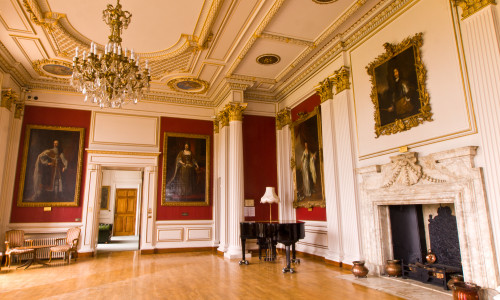 Vanbrugh was keen that the ‘the Figure and Proportions that make the most pleasing fabric, And not the delicacy of the Ornaments.’ This issue of symmetry was Coleman’s key problem and one that Vanbrugh had to resolve. He needed to relate the centre line of the new front to the existing rooms and courtyard behind and to the garden and ornamental canal in front. This was solved by extending the front to the west so that the centre lines met and by inserting a large extra room between the drawing room and the bedchamber, a ‘room of parade’, the Saloon. The giant fluted Corinthian pilasters and columns in the Saloon are typical of the Vanbrugh style creating an English Baroque theatrical backdrop.
He described his plan:
There was therefore a necessity for some new Contrivance. And I thought, there cou’d nothing in reason be Objected to being Surpris’d with a large Noble Room of Parade between the Drawing room and Bedchamber; especially since it falls so right to the Garden, that the Door is in the Middle of the Room, and takes exactly the Middle Walk and Canall.2
The Earl was at first quite sceptical about the addition of another state room, when the White Hall had only been remodelled in the previous decade, but Vanbrugh prevailed.
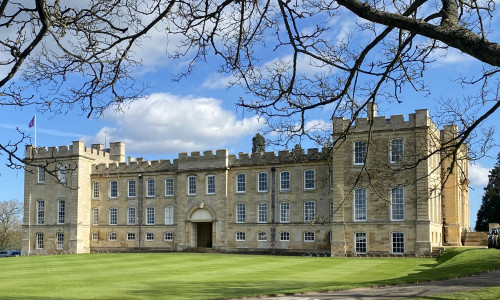 As Kimbolton was in the words of Simon Thurley, ‘an architectural hotchpotch’, Vanbrugh argued that the castle’s outer face should be rebuilt, though he was conscious of the need to reuse materials as Manchester’s budget was considerably less than that of the Howards or the state coffers used to build Blenheim. The castle theme was always central to Vanbrugh’s plans, as shown in a preliminary scheme with a perimeter wall and towers. In the end, achieved his ‘Castle air’ principally through battlements on the roofing and corner towers, reminiscent of a medieval fortified house. He was determined to give the Castle ‘a manly beauty’ that would nod to its medieval origins and its Tudor connections to Katherine of Aragon but would also be a building that Manchester could show to his Italian friends with pride. As Vanbrugh said,
As to the Outside, I thought ‘twas absolutely best, to give it Something of the Castle Air, tho’s at the Same time to make it regular. And by this means to, all the Old Stone is Serviceable again; which to have had new wou’d have run to a very great Expence; This method was practic’d at Windsor in King Charles’s time, and has been universally Approv’d, So I hope your Ldship won’t be discourag’d, if any Italians you may Shew it to, shou’d find fault that ‘tis not Roman, for to have built a Front with Pillasters, and what the Orders require cou’d never have been born with the Rest of the Castle3.
As later seen in his own house, Vanbrugh Castle, Vanbrugh developed a romantic attitude to the medieval past, but it is also likely that he knew that this design would appeal to Manchester, who was always anxious to perpetuate the myth of his long noble lineage and distance himself from the reality of his humbler Northamptonshire background.
I’m sure this will make a very Noble and Masculine Shew; and is of as Warrantable a kind of building as Any. I hope I need say no more, to gain your Ldships Approbation of it, than what I have done; and I shall be very glad, if when you return, You are pleas’d with it.4
The medieval evocation effect was also a feature of the North Side. However, the battlement effect was spoilt by the addition of a new attic story in 1869 and infilling of some of the low colonnade of depressedarches on the ground floor. We are indeed grateful that the Victorian dukes did not have sufficient funds to further damage the aesthetics of the Castle with planned changes that would have completelymangled Vanbrugh’s design.
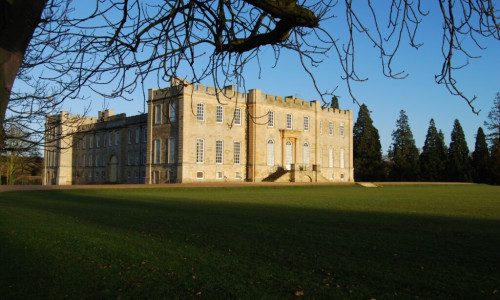 As Charles Saumarez Smith has concluded, ‘There is a paradox in the design of Kimbolton. At both Castle Howard and Blenheim, Vanbrugh had been interested in complexity of visual effect. But at Kimbolton, he adopted a much plainer and more austere style: what he regarded as ‘Manly Beauty’. …. Maybe it was because, by the standards of Blenheim, the changes to Kimbolton were comparatively cosmetic, creating new façades and making modifications to the internal layout of an existing courtyard house which was, unlike Blenheim, a genuine castle.’
Although Vanbrugh made preliminary designs for the East Front, for some reason, perhaps costs, they were never realised, and the Portico from around 1719 is probably the work of Thomas Archer. Vanbrugh died in 1726 and Manchester in 1722. They were both grateful to George I, who knighted Vanbrugh in 1714 and made Charles Montagu a Duke in 1719.
Vanbrugh’s reputation has ebbed and flowed through the centuries, and we are particularly grateful that the Adam brothers were his greatest champions in the later eighteenth century, as can be seen in the Gatehouse, designed in a monumental manner by Robert Adam to blend with Vanbrugh’s masculine style.
Sources
Charles Saumarez Smith John Vanbrugh, 2025
Kerry Downes Sir John Vanbrugh, 1987
Ophelia Field The Kit-Cat Club, 2008
Vaughan Hart Sir John Vanbrugh, 2008
Helen Jacobsen Venetian Influences; The Earl of Manchester, 2011
Julie Brown Music, Morality and Political Allegory in Pellegrini’s Kimbolton Castle Mural, 2024
 Back to homepage