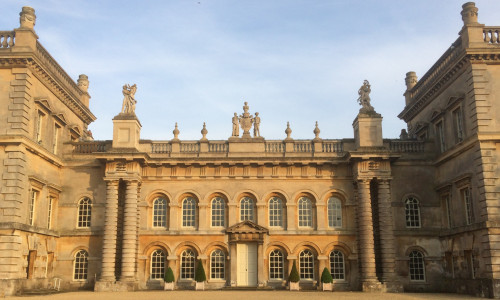
When Sir John Vanbrugh turned his thoughts to Grimsthorpe Castle, Lincolnshire, home of his friend Robert Bertie, 1st Duke of Ancaster, he was working with the oldest house in his career. The King John Tower dates back to the 1200s; the medieval house was hastily enlarged for a visit by Henry VIII in 1541, into the present large courtyard form. Vanbrugh’s hopes of remodelling all four wings were not followed through (work stalled at his death in 1726), and so Grimsthorpe Castle is a fascinating mixture of a largely Tudor house behind Vanbrugh’s statement entrance front.
The north front exterior and interior are in complete agreement, powered by the repeated use of round-headed windows. The great hall interior is created from the two levels of the arcades on every wall, either as windows, blind niches and painted surfaces, or open to show hints of the graceful stairs at each end. Without the ceiling, you could be in an Italian, or better still, ancient Roman courtyard. There are ancient Roman clues outside, easy to miss; the pavilions in the forecourt and the massively projecting corner of the house are topped not by conventional urns at each corner, but by what I think are copies of ancient Roman altars, those on the house with carved swags. And castle? Well, the Romans were the first castle builders in England, followed by Norman Romanesque keeps; massive and full of round-arch motifs.
Rome in 1720s England is not too fanciful: you can meet the 1st and 2nd Dukes of Ancaster as ancient Romans in the form of magnificent funerary statues in Edenham parish church. The most famous collection of ancient Roman and Greek sculpture, the Arundel marbles, had been exhibited since the 1660s at the University of Oxford, with plenty of altars on display. Illustrated books describing notable collections of antiquities in Italy were in English libraries, along with sculptures shipped back from Grand Tours. Fully classical architecture by Inigo Jones back in the early 1600s started a fully classical, Palladian, revival. Vanbrugh steered his own course through classicism, but the deployment of massive paired columns at Grimsthorpe (also seen at Seaton Delaval), the arcades fit for a colosseum, and the flourish of the skyline altars in place of urns, suggest that he too was thinking about an ancient Roman history in English fields.
 Back to homepage