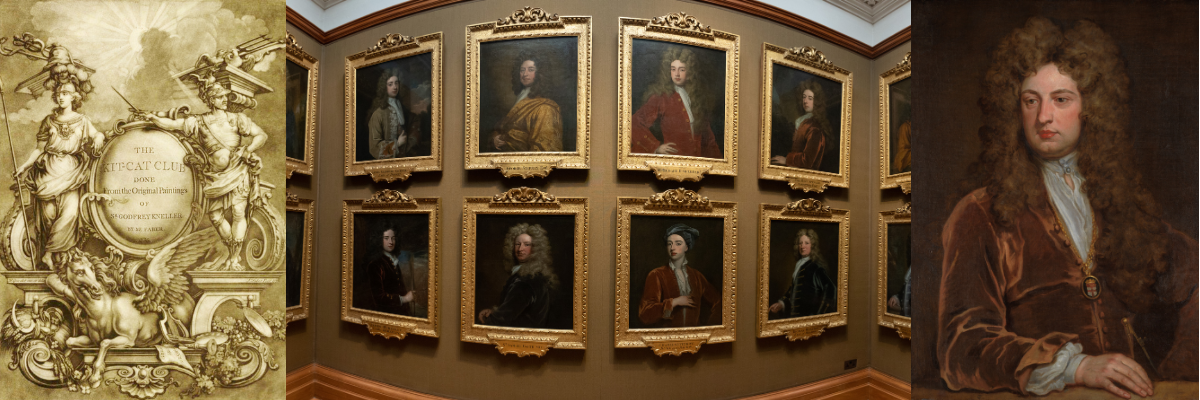
Vanbrugh and the Kit-Cat Club
By Ophelia Field
Patronage was the whole raison d’être of the Kit-Cat Club (1690s-1720). Founded by publisher-bookseller Jacob Tonson as a means of connecting his young authors with aristocratic officeholderswho could support them – usually by means of sinecures, licences, honours or other jobs – this London club was one of the first of its kind. It was certainly the first to combine a clear political agenda (tied to the ‘Whig Junto’) with an equally clear cultural agenda (namely, patriotic promotion of English arts and letters, especially architecture, journalism and opera). With this combination as the basis for its patronage, it filled an important gap during a period between declining royal patronage, when William III was seen as relatively disinterested in English literature, for example, and the advent of professional literary incomes after the first Copyright Act of 1709.
Tonson’s partner in founding the Club was the bibliophile jurist and Junto member John Somers, 1st Baron Somers, who in many ways epitomised the Club’s ideal of a modern Maecenas, conversing with his fellow members over their Thursday ‘kit-cat pies’ as if they were his equals, regardless of their ranks and fortunes. Aristocrat members gained the cultural kudos of associating with ‘wits’, and hopefully being mistaken for wits themselves, while in return the wits garnered social capital that they hoped to exchange for real capital – for example, through subscription publication of their works. Playwrights William Congreve (Tonson’s lodger as well as author) and John Vanbrugh were among the first authors that the Kit-Cat patrons supported, Vanbrugh joining sometime after the success of his first play at the Theatre Royal in 1696. Many of Vanbrugh’s most important architectural commissions, such as Castle Howard, came via the Club, and the building of the Queen’s Theatre on the Haymarket, which Vanbrugh designed and managed, was funded by Kit-Cat subscription in order, they hoped, to create a home for English opera seria. Others such as Addison and Steele profited as much if not more from their membership.
The Kit-Cat can therefore take a large share of credit for promoting an ethos of semi-meritocratic patronage, guided by intellect and talent, by clubbable conviviality and bonds of male friendship,and by partisan loyalty, rather than by traditional ties of elite kinship. This lesson was not wasted on its young member Robert Walpole, who later excelled in turning patronage of writers into government propaganda.
 Back to homepage