John Vanbrugh, The Playwright
By Dr Annette Rubery
The curtain lifted on John Vanbrugh’s theatrical career in 1696, but he was probably writing plays from a much earlier date. His first play, The Relapse, or, Virtue in Danger, premiered in November 1696 at Drury Lane (one of two official London theatres in this period). It was unusual for a debut because it was a sequel to another play, the sentimental comedy Love’s Last Shift, or The Fool in Fashion, which had appeared earlier that year. The latter was written by Colley Cibber – an actor at Drury Lane – who cast himself as the fop, Sir Novelty Fashion. The play was popular, not least because of Cibber’s performance, but its sentimentalism clearly struck a chord with Vanbrugh, who set out to write a response.
The Relapse shows us that Vanbrugh’s worldview was, at best, pessimistic. In the play, he returns to Cibber’s characters – Loveless and Amanda – but instead of a moral enlightenment, we have a story of astonishing cynicism. This time, Loveless falls for Amanda’s cousin, Berinthia, whom he first sees by chance at the playhouse. In place of the classic love triangle, we have a quartet: a local gentleman, Worthy, falls for Amanda, and so the two interlopers join forces to split the married couple, each claiming a partner for themselves. The subplot is a class satire revolving around Sir Novelty (now styled Lord Foppington) and his brother, Young Fashion. One of the cherished visual gags of Love’s Last Shift was the moment when Sir Novelty’s gigantic wig was carried on-stage in its own sedan chair. In The Relapse, Vanbrugh wrote a scene in which Foppington is visited by his periwig-maker – presumably to allow for an even bigger wig-gag.
As with all his original plays, Vanbrugh did not conclude either of the plots with a happy ending, and the first performance of The Relapse was almost ruined by one of the actors, who stumbled onstage drunk and manhandled Mrs Rogers, who was playing Amanda. Despite this unpromising beginning, the piece enjoyed a respectable run of six nights and Foppington was recognised as a landmark performance by Cibber.
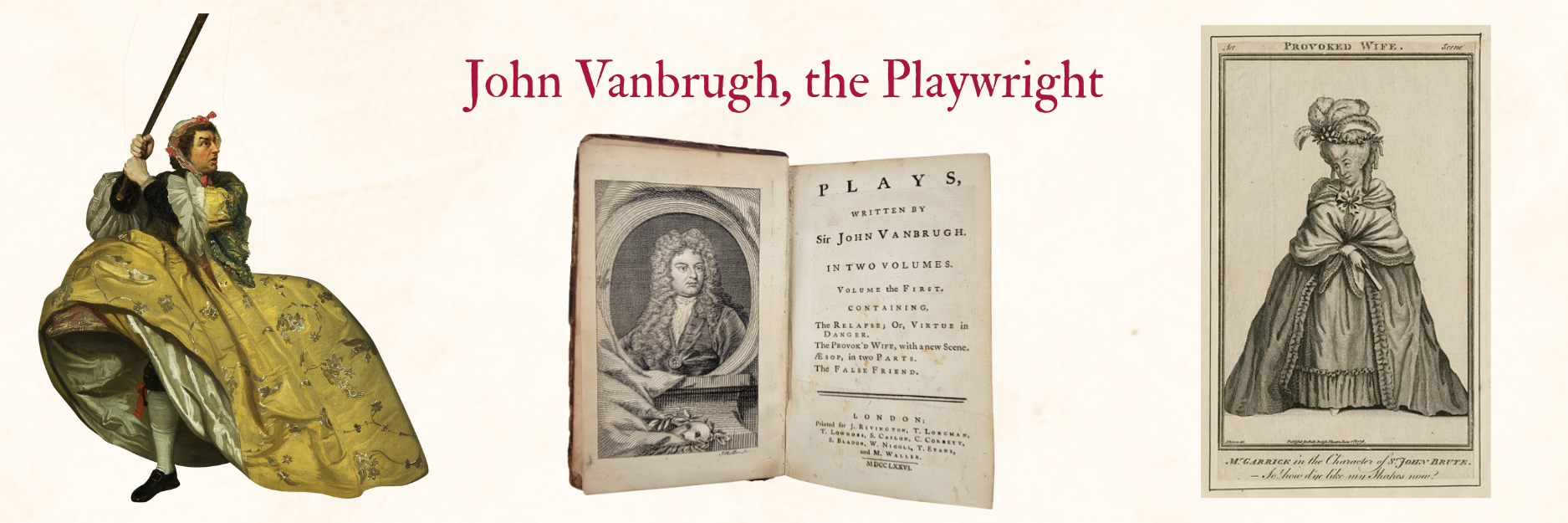
If The Relapse seemed pessimistic about marriage, Vanbrugh’s next original play made an even stronger argument for singlehood. The Provok’d Wife premiered at Lincoln’s Inn Fields theatre around April 1697. The plot focuses on Sir John Brute and his wife: two people who married for the wrong reasons (in his case, sex; in hers, money). Sir John hates the sight of his wife and Lady Brute tolerates her husband’s drunkenness and philandering with grim determination. Yet, despite attention from a promising suitor (Constant), Lady Brute is determined to remain faithful to her husband. Again, there is a comic subplot – this time with a female fop (Lady Fancyfull) – along with some risqué jokes about the clergy which Vanbrugh would later come to regret. As with The Relapse, The Provok’d Wife does not end in happiness for all the characters.
As Vanbrugh knew, the stage was a microcosm for society, and these early plays grapple with all the anxieties about governance which had been swirling since the Revolution of 1688. But they are particularly radical because, instead of Christian morality, they subscribe to a Hobbesian view in which humankind is flawed, and strong governance is only justified by the social contract. As Lady Brute says of her husband: ‘But he han’tkept his word. Why then I’m absolved from mine – ay, that seems clear to me. The argument’s good between the king and the people, why not between the husband and the wife?’
 Back to homepage