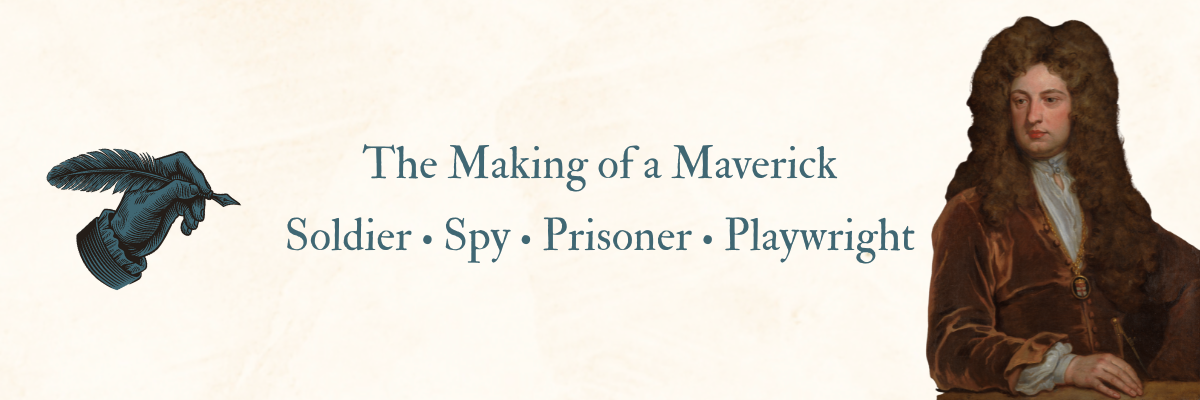
As Sir John Vanbrugh is celebrated in this, his tercentenary year, attention naturally turns to the great houses that define his architectural legacy. Best known as a Baroque architect, Vanbrugh’s dramatic use of shadow and movement is all the more astonishing given that he came to architecture later in life with no formal training. Yet when viewed in the context of his wider biography, this apparent improbability begins to make sense.
Vanbrugh’s life can be understood as unfolding in two remarkable halves. The first is shaped by danger, travel, political intrigue, and imprisonment; the second by architecture, creativity, and enduring legacy. Together, they tell the story of a man whose extraordinary experiences forged an equally extraordinary imagination. To understand Vanbrugh’s architectural language, therefore, it is essential to look beyond the buildings themselves and examine the formative years that preceded them.
How might Vanbrugh’s early life have shaped his architectural style? His buildings are as bold, uncompromising, and dramatic as his earlier political activism and provocative plays. This raises a compelling question: does an understanding of Vanbrugh’s early life offer a new way of reading his architecture, or do his buildings themselves provide insight into the man he was? This article explores Vanbrugh’s early life, tracing his experiences as a maverick, soldier, spy, and prisoner, to reveal how these formative years helped shape one of Britain’s most distinctive architectural voices.
John Vanbrugh was born in London on 24 January 1664, four years after the Restoration of the Monarchy, to Giles Vanbrugh and Elizabeth Carleton. His father was descended from Protestant Flemish cloth merchants, the Van Bruggs, who had settled in London in the early seventeenth century to escape religious persecution. His mother came from a well-connected English gentry family, and his grandfather, Sir Dudley Carleton, had been a minor diplomat under Charles I, providing Vanbrugh with both heritage and established social connections. Following the outbreak of the Great Plague in 1665, the family relocated to Chester.
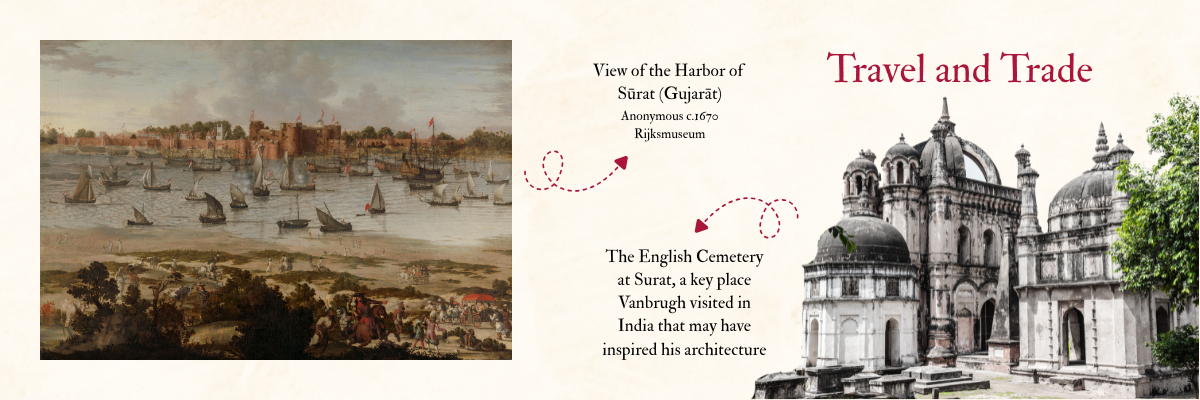
In 1681, Vanbrugh entered the wine trade, though the firm soon collapsed. Making use of his father’s connections, he subsequently joined the East India Company as a factor (trading agent) in 1682, at the age of eighteen. On 4 May 1683, he set sail for India aboard the Scipio Africanus. After a lengthy voyage around the Cape of Good Hope, Vanbrugh arrived in Sūrat, Gujarat, north of modern-day Mumbai. He spent approximately two years in this thriving cosmopolitan city, encountering a landscape unlike anything he had known in England. Surat was filled with Mughal tombs and paradise gardens, spaces where merchants retreated during the heat of the day. These inspired the monumental tombs of the English Cemetery which impressed Vanbrugh. Despite this, he found merchant life stifling and increasingly unsatisfying and he returned to England on 16 February 1685.
Although his stay in Surat was relatively brief, it left a lasting impression. Some twenty-six years later, Vanbrugh produced sketches from memory of elements of the English Cemetery, including the imposing tomb of the Oxenden brothers. These forms almost certainly informed his later architectural language, perhaps even the towers at Blenheim Palace. His early exposure to monumental funerary architecture, garden layouts, and bold massing can be seen as the beginning of a visual and experiential archive that he would later draw upon. Long before he turned to architecture formally, Vanbrugh was already absorbing global influences, cultivating a taste for grandeur, drama, and scale that would become defining characteristics of his later work.
In 1686, the first year of the reign of James II, Vanbrugh joined the English army as a junior officer, receiving a commission in the Earl of Huntingdon’s Regiment. James II’s accession, as a Roman Catholic monarch, sat uneasily with the staunchly Protestant Vanbrugh. During his brief period of military service, he gravitated towards Whig political circles and became increasingly involved in opposition to the king’s autocratic reforms. After less than a year in service, Vanbrugh resigned his commission in protest.
Determined to see James II deposed in favour of the Protestant William of Orange, Vanbrugh travelled to Holland in early 1688 with his Bertie cousins of Grimsthorpe Castle, who shared his political disillusionment. The group were almost certainly engaged in discussions with William or his supporters, joining a broader network of figures encouraging him to invade England and claim the throne.
Later that summer, while travelling in France, the twenty-four-year-old Vanbrugh was arrested in Calais for his support of William. The French authorities held him as a hostage in place of a prominent French spy in England. Vanbrugh attempted to secure his freedom by posing as a supporter of James II and bombarding Louis XIV with letters of protestation. Despite these efforts, he remained imprisoned in France for the next four years, during the early reign of William and Mary.
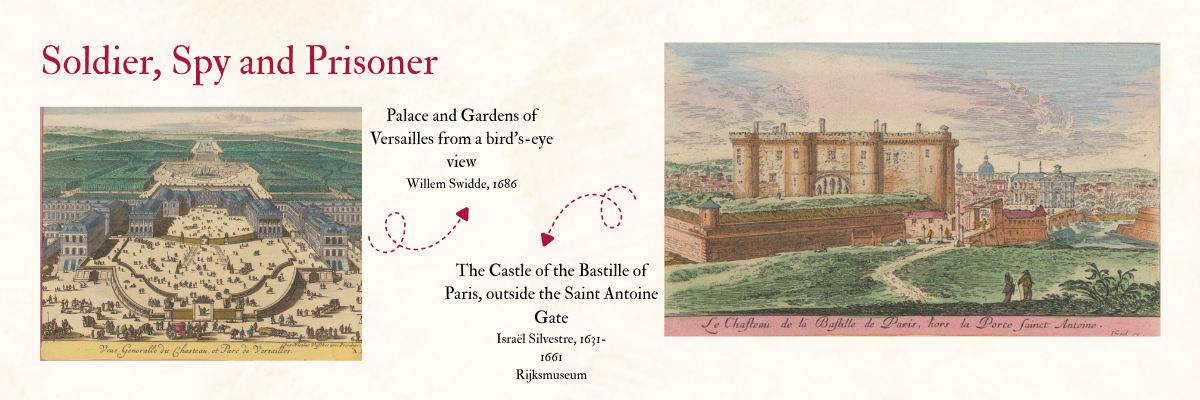
This period included confinement in the Bastille in Paris, where conditions were comparatively more lenient. Yet even in captivity Vanbrugh remained resourceful: intelligence smuggled to England ultimately contributed to his release in 1692, secured through a prisoner exchange following appeals to the Secretary of War, William Blathwayt.
During a period of parole, Vanbrugh enjoyed what might be described as a mini–Grand Tour of Paris, including a visit to the Palace of Versailles. After five years abroad, he returned to England in 1693. His hostility towards France remained undiminished, and in 1694 he volunteered to fight at the bloody Battle of Camaret Bay on the 7/8th of June. Praised for his bravery, he was promoted to Captain in the Marines, achieving the status of a war hero. In 1702, he received a further commission as a captain in his original regiment and was thereafter widely known as Captain Vanbrugh until his knighthood under George I.
Vanbrugh’s experiences as soldier, conspirator, prisoner, and war hero reveal a man shaped by conflict and political conviction. His exposure to French military architecture, where he was imprisoned within fortified spaces, and first-hand encounter with the theatrical grandeur of Versailles all left discernible traces on his architectural imagination. The commanding façades and dramatic spatial sequences of Blenheim Palace and Castle Howard reflect not only Baroque influence, but also a temperament forged through defiance and a belief in power expressed through architecture.
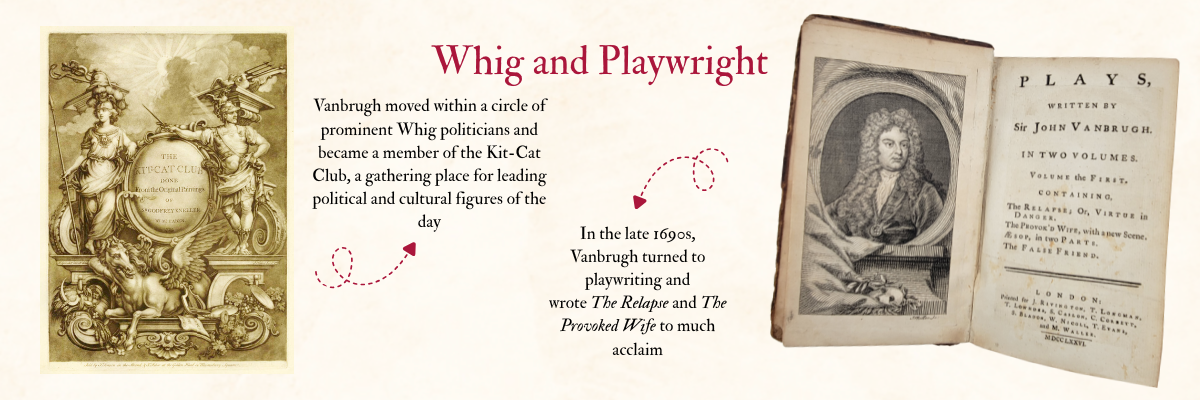
On his return to England in 1693, Vanbrugh moved within a circle of prominent Whig politicians and became a member of the Kit-Cat Club, a gathering place for leading political and cultural figures of the day. Its members, which included writers, aristocrats, and politicians, were united in their support for constitutional monarchy, parliamentary government, and the Protestant Succession established by the Glorious Revolution. Through the club, Vanbrugh forged lasting relationships with influential patrons, many of whom would later commission him to design their country houses, binding his creative fortunes closely to Whig political culture.
In the late 1690s, Vanbrugh turned to playwriting and quickly established himself as one of the most original voices on the English stage. In 1696, he wrote The Relapse, staged at the Theatre Royal later that year to great acclaim. Originally conceived both to repay a debt to a friend and as a pointed response to Colley Cibber’s sentimental comedy Love’s Last Shift, the play subverted conventional moral resolution with sparkling wit and strikingly modern prose. Its success catapulted Vanbrugh to literary fame.
This was followed in 1697 by The Provoked Wife, a play written earlier (possibly during his imprisonment), which proved equally popular and more provocative. Vanbrugh relished using comedy to confront serious moral questions. His characters were more emotionally nuanced than those typical of Restoration comedy, helping to steer English literature towards the emerging culture of sensibility later associated with writers such as Jane Austen. Both comedies were celebrated for their wit, boldness, and moral seriousness, further enhancing Vanbrugh’s standing among his Whig contemporaries.
Vanbrugh’s belief that “the stage is a glass for the world to view itself in” reveals a creative philosophy that would later extend beyond theatre. Just as his plays were carefully staged to expose power and conflict, his architecture can be understood as a form of spatial drama. The shared emphasis on revelation and emotional effect suggests a continuity between stage and stately home, with Vanbrugh treating architecture as another medium through which society could be observed, questioned, and performed.
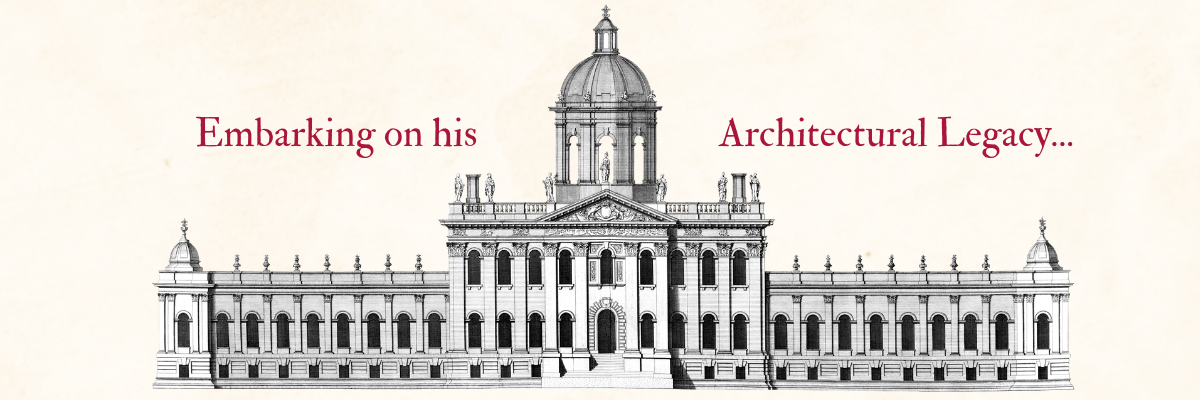
In 1699, Vanbrugh received his first major architectural commission from his friend and fellow Kit-Cat Club member Charles Howard, 3rd Earl of Carlisle, who entrusted him with the design of Castle Howard in Yorkshire. That summer, Vanbrugh toured northern England, visiting newly built country houses, sharing preliminary drawings, and seeking advice from aristocratic patrons. This period marked his decisive transition from celebrated playwright to practising architect.
Despite having no formal architectural training, Vanbrugh embarked on a career that would redefine English Baroque architecture, producing some of its most commanding monuments, including Blenheim Palace, Kimbolton Castle, Grimsthorpe Castle, Seaton Delaval Hall, and Stowe. From this point onward, his life became dominated by patronage and creative ambition, the second great chapter of a remarkable life.
The dramatic contrast between danger and creativity, confinement and imagination, risk and reward, help to explain why Vanbrugh’s architecture remains so distinctive. His buildings are bold, theatrical, and uncompromising, shaped by a life lived intensely, and by an imagination forged long before he ever drew his first architectural plan.
 Back to homepage