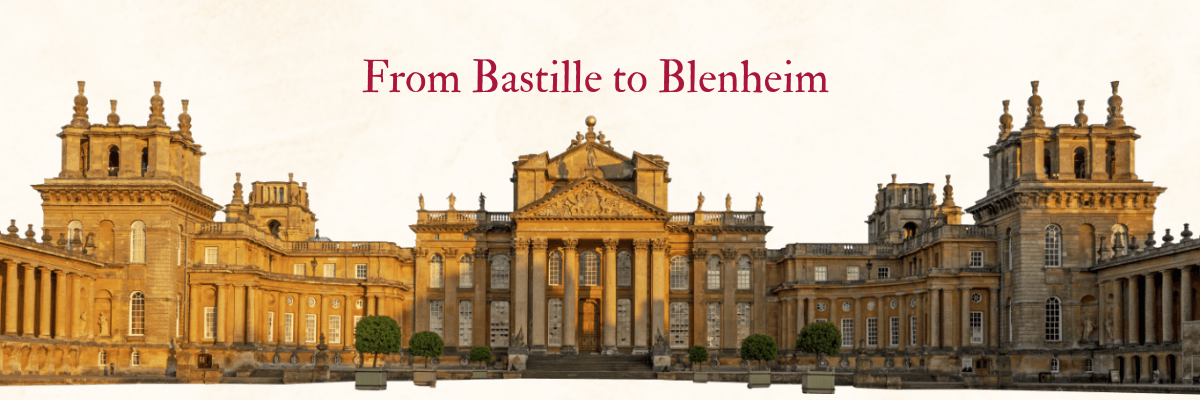
Blenheim Palace is an original Vanbrugh design. Following the Duke of Marlborough’s victory at the Battle of Blenheim in August 1704, Queen Anne sought to reward him with a country house far grander than anything previously seen in England, a fitting monument to his military brilliance. Vanbrugh, whose work at Castle Howard had earned widespread admiration, was tasked with creating a national symbol of monumental scale. Yet his genius came with challenges: fierce rivalries, political intrigue and personal conflicts, made more complicated by the fact that it was paid for by the Queen, not through the Exchequer.
The Duke, who knew Vanbrugh from Kit-Cat Club dinners and theatre meetings, commissioned him to design a building worthy of a national hero who had defeated the French. The result is a striking example of English Baroque: a structure of awe-inspiring size and rich ornamentation. Collaborating with Nicholas Hawksmoor, former assistant to Sir Christopher Wren, Vanbrugh set out to create a building that was, in essence, monument first, castle second, and private house third.
In contrast to the Duke, Sarah, the first Duchess of Marlborough, preferred a relatively modest country house for their retirement. Vanbrugh, convinced he was fulfilling the wishes of the Queen and the Duke, pressed on, constructing the palace from 1705 on an immense scale, with soaring towers, vast courtyards, and a monumental bridge over a tiny river. By 1709, the great façades and sweeping avenues were beginning to take shape, extending the theatricality of the architecture into the surrounding landscape. But with the Duke often away on military campaigns, the Duchess increasingly assumed control as the client, and made Vanbrugh’s life exceedingly difficult. After five years of mounting quarrels, she ordered work to halt in 1710, though construction later resumed and was continued by the Marlboroughs themselves after they returned to London in 1714.
The palace hasn’t always looked as it does today. The site’s history stretches back to 1129, when Henry I constructed the first enclosed park, complete with seven miles of wall and exotic animals such as lions and camels. His grandson, Henry II, transformed the hunting lodge into Woodstock Palace, the first of two palaces on the Blenheim estate. Woodstock Manor, built from scratch, still stood in 1705 when Vanbrugh began work on the palace we see today. Despite the Duchess’s insistence on demolishing the old house, Vanbrugh chose to renovate it for his own use and, in 1713, moved in. Furious when she discovered this, the Duchess ordered its demolition, further straining her already fraught relationship with Vanbrugh. Today, visitors can spot the concrete plinth marking where Woodstock Manor once stood.
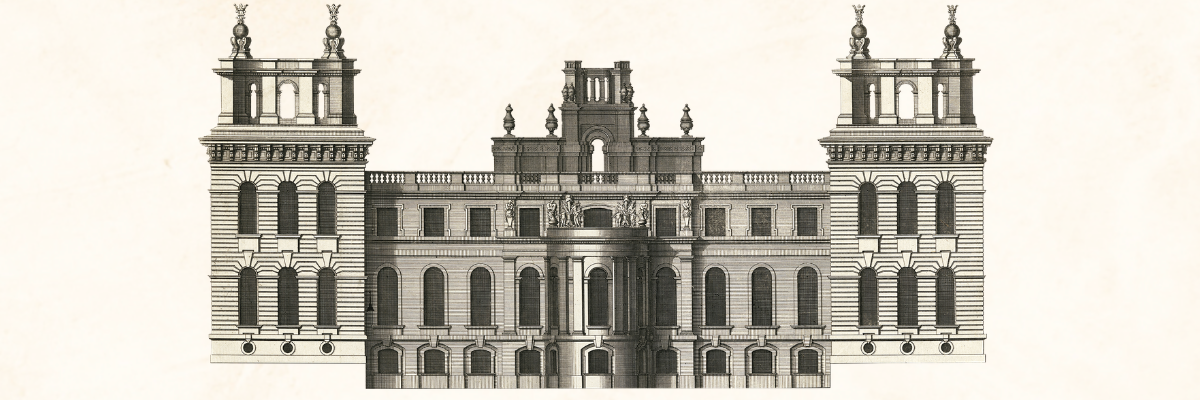
By 1710, the Duchess’s relationship with Queen Anne had also deteriorated, and the Marlboroughs found themselves besieged by political intrigue. Their fall from favour was swift and dramatic. Treasury payments for Blenheim Palace were halted, leaving Vanbrugh and others owed £45,000 (roughly £4 million today). Unsurprisingly, all construction work ground to a halt. The Marlboroughs went into self-imposed exile abroad in 1712, returning only the day after Queen Anne’s death on 1st August 1714.
When George I ascended the throne, the Treasury settled the outstanding debts, but no further funds were provided for completing Blenheim Palace. With little choice, the Duke had to continue construction at his own expense, retaining both Vanbrugh and Hawksmoor. In 1714, Vanbrugh was among the first to be knighted by George I (reportedly at Marlborough’s request), a recognition of how much he was esteemed by the Duke despite the political and financial turmoil surrounding the project.
From this point, disputes over who should pay the masons and how the project should be completed became almost constant. Work resumed in early 1716, but under very different circumstances. The Duke refused to cover the wages that the Crown had previously paid, and many master craftsmen, including the renowned carver Grinling Gibbons, were still owed substantial sums. Unsurprisingly, they refused to return. The work was instead carried out by other masons, who accepted the lower rates their masters had rejected, ensuring the palace’s construction continued, albeit under strained conditions.
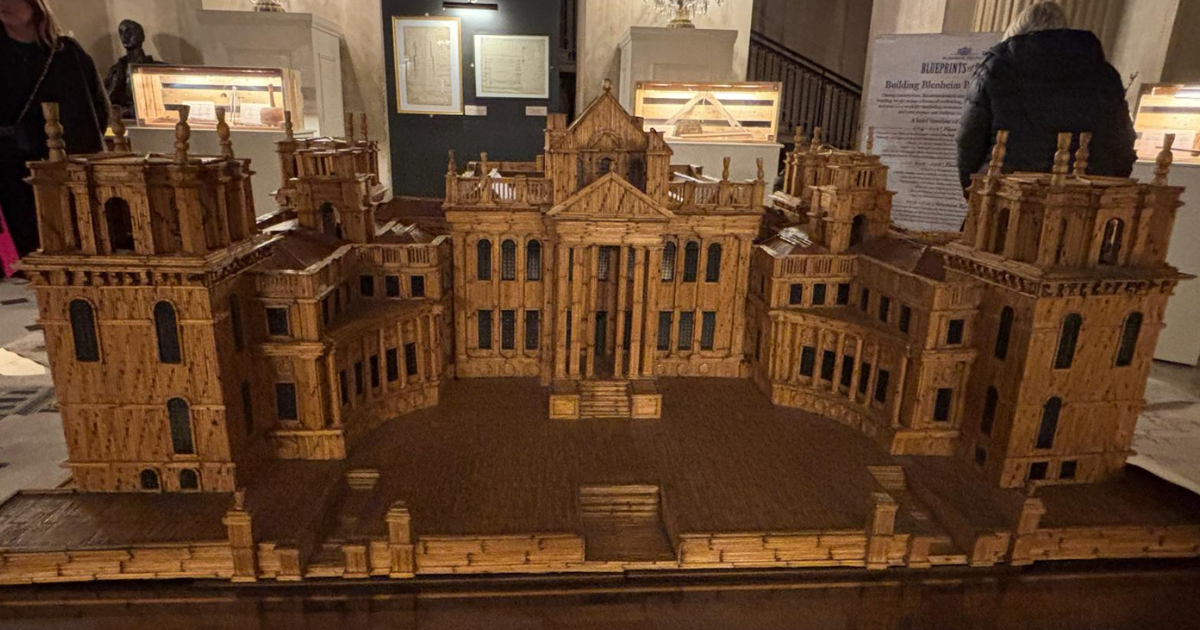
By 1716, tensions between John Vanbrugh and the Duchess of Marlborough had also reached a breaking point. When Vanbrugh discovered that the Duchess was circulating a detailed account of every perceived flaw in his work, he withdrew from the project in frustration. In a mix of anger and exasperation, Vanbrugh abandoned Blenheim, leaving the palace and one of the most fraught collaborations in English architectural history.
Nicholas Hawksmoor continued to oversee Blenheim’s construction from a distance, while day-to-day supervision fell to the skilled cabinet-maker James Moore, who had the Duchess’s complete trust. After the Duke of Marlborough’s death in 1722, Hawksmoor returned to complete key features, including the Triumphal Arch and other outworks. Vanbrugh, however, remained in permanent disgrace; in 1725, he was even denied entry to the park when he attempted to see the palace. Tragically, he never witnessed his masterpiece in its entirety, reduced to peering over the garden wall when he brought his wife to view it. He died the following year.
Despite the many obstacles of soaring costs, political upheaval, and the bitter disputes with the Duchess of Marlborough, Blenheim Palace stands today as Vanbrugh’s crowning achievement: a theatrical vision of power and patriotism, defining the English Baroque and immortalising victory in stone.
 Back to homepage